Jasmine Soule
Professor Robinson
Analytical and Persuasive Writing
16 November 2008
Vogler, Christopher. “The Writer’s Journey” “Stories are alive.” The Writer’s Journey: Mythic
Structure for Writers. 3rd Edition. Studio City, California Michael Wiese Productions, 2007.
293-312.
Summary:
In this section Vogler talks about how the writer’s journey and the hero’s journey are one in the same. In most cases the writer of the story uses personal experience to create, the ordeal or shadow or threshold guardians. For instance the shadow in the story could be confusion or low self-esteem about the writer. Vogler also talks about the meaning of being a Shaman, which means “wounded healer.” Shamans are believed to have broken every bone and then been put back together. Writers have been known to experience some type of splinter in their life too. Writers and Shamans both have the ability to travel around the world and create imaginative or real stories out of their adventures. Furthermore, in the next section Vogler begins to talk about how the stories are alive for human purpose. These stories in his eyes are meant to wake the reader up or teach a listen, or mess with the reader’s emotions. These stories can bring up challenging question for the brain to wonder about. Vogler then retells his experience of reading “Rumpelstiltskin.” He also begins to speak about the power of wishing and how the hero in some cases wishes the difficult situation was different. This also goes into the difference between wanting and needing something. Sometimes the hero wants something but really he or she needs to learn the lesson in the story. Also the audience has wishes too; the stories provoke the audience to start wishing things about the story. In the end, in most cases the wishes are granted for the audience and the hero.
Reaction:
I really like that this was the last section to read because I feel that it ties everything up in the end. This section helped me to understand the meaning of creating a wonderful story. These stories may come from around but the special part about it is the writer’s imagination. These stories also help our imagination in a good ways but exploring different scenarios. I also enjoyed reading about the power of wishes and how those wishes make the story more intriguing when they are granted to the audience.
Questions:
1. Can a story still be a great story if the audience’s wishes are not granted?
2. How does the hero realize what he or she needs in their lives?
3. What is one movie that provoked emotions and questions after seeing it and why?
Monday, November 17, 2008

Friday, November 14, 2008
Reflection and Action
Rhetorical analysis - I thought my movie, image, book, and song were great examples that reflect my project two. These four modes helped me get an idea of what I was trying to display in my project two. The 4 modes helped portray my ideas and beliefs about project two.
Interview - I plan on interviewing someone who has personal experience with helping people in Africa. I would like to interview someone, who has some extent of knowledge and experience with Africa. I don't exactly know how I will interview this person but I hope to gain some information about the feeling and the appreciation of helping people.
Volunteers - I plan to volunteer for either the Aids Partnership or Child/ Youth services. I have volunteered in the past but this time will be different for me. I want hope to learn even more after volunteering about myself and others. This is a great opportunity to discover amazing stories about others or to help another person.
Interview - I plan on interviewing someone who has personal experience with helping people in Africa. I would like to interview someone, who has some extent of knowledge and experience with Africa. I don't exactly know how I will interview this person but I hope to gain some information about the feeling and the appreciation of helping people.
Volunteers - I plan to volunteer for either the Aids Partnership or Child/ Youth services. I have volunteered in the past but this time will be different for me. I want hope to learn even more after volunteering about myself and others. This is a great opportunity to discover amazing stories about others or to help another person.
Tuesday, November 11, 2008
4 Modes
The movie Hotel Rwanda is an extraordinary movie because it talks about genocide in Rwanda. This movie is seen through the eyes of a family. They are split apart because of the chaos in Rwanda. This chaos is about two tribes that are at war with each other and both want to destroy each other. The main character Don Cheadle, tries to save his family and others from the soldiers that are causing disorder. The actor Don Cheadle has also done a lot for the people of Darfur by trying to make aware of the events that are occurring. The purpose of picking this movie is to show the similarities of the genocide in Rwanda with the genocide in Darfur. This also give the audience and look at the emotional toal it has on the families living through this horrific event. I enjoyed looking at this movie because it truly touched me and I think this would be great to watch to understand what is happening in Darfur.
http://www.youtube.com/watch?v=mYwuXvA589A
The song “War Child” by Emmanuel Jal is a great song to represent the feelings and beliefs of a person who has been in a war. Emmanuel Jal was a war child at one point in his life. He talks about the struggles and issues he had to deal with as a child. This song expresses ethos and pathos through the lyrics of the song. When hearing this song, the audience can tell the pain and suffering he went through as a child and also what he feels should happen. He was a war child in the Sudanese War and now he is telling his story through his music. He is a survivor and hopes to change the world with his music and bring peace.
http://www.youtube.com/watch?v=A0Nd87lFcdc
I believe that the image I chose to use for one of my mode is simple and a strong statement. I think that the situation in Darfur is horrible and should be made more aware of than what it is now. This image is telling people to not just stand by and not help, but to take a stand and make aware of the genocide. The lives of the people of Darfur are crucial and people around the world should take notice to it. I like this image because it goes straight to the point and catches the attention of the reader. There are also facts on this image that invoke the element s of ethos, pathos and logos.
The book Not on Our Watch: The Mission to End Genocide in Darfur and Beyond, is a great book for people to read because it talks about what is happening in Darfur and other crucial areas around the world. Don Cheadle, an actor and activist, took part in writing this book to make aware of the issues and events that are occurring in Darfur. This book is about the actions anyone can take to help make aware of the genocide or raise funds or write letters. Don Cheadle also talks about other places in the world that has turmoil and needs attention so that people can get help. This is a great book for those who are conscious of this chaos and wants to help the cause.
http://search.barnesandnoble.com/booksearch/isbnInquiry.asp?r=1&ISBN=9781401303358&ourl=Not%2Don%2DOur%2DWatch%2FDon%2DCheadle
http://www.youtube.com/watch?v=mYwuXvA589A
The song “War Child” by Emmanuel Jal is a great song to represent the feelings and beliefs of a person who has been in a war. Emmanuel Jal was a war child at one point in his life. He talks about the struggles and issues he had to deal with as a child. This song expresses ethos and pathos through the lyrics of the song. When hearing this song, the audience can tell the pain and suffering he went through as a child and also what he feels should happen. He was a war child in the Sudanese War and now he is telling his story through his music. He is a survivor and hopes to change the world with his music and bring peace.
http://www.youtube.com/watch?v=A0Nd87lFcdc
I believe that the image I chose to use for one of my mode is simple and a strong statement. I think that the situation in Darfur is horrible and should be made more aware of than what it is now. This image is telling people to not just stand by and not help, but to take a stand and make aware of the genocide. The lives of the people of Darfur are crucial and people around the world should take notice to it. I like this image because it goes straight to the point and catches the attention of the reader. There are also facts on this image that invoke the element s of ethos, pathos and logos.
The book Not on Our Watch: The Mission to End Genocide in Darfur and Beyond, is a great book for people to read because it talks about what is happening in Darfur and other crucial areas around the world. Don Cheadle, an actor and activist, took part in writing this book to make aware of the issues and events that are occurring in Darfur. This book is about the actions anyone can take to help make aware of the genocide or raise funds or write letters. Don Cheadle also talks about other places in the world that has turmoil and needs attention so that people can get help. This is a great book for those who are conscious of this chaos and wants to help the cause.
http://search.barnesandnoble.com/booksearch/isbnInquiry.asp?r=1&ISBN=9781401303358&ourl=Not%2Don%2DOur%2DWatch%2FDon%2DCheadle
Monday, November 10, 2008
Anti Bib 10
Jasmine Soule’
Professor Robinson
Analytical and Persuasive Writing
09 November 2008
Vogler, Christopher. “Epilogue: Looking Back On the Journey.” The Writer’s Journey:
Mythic Structure for Writers. 3rd Edition. Studio City, California: Michael Wiese Productions,
2007. 231-291.
Summary:
In this section, Vogler talks about how the hero’s journey is a guideline. Using these guidelines will help make a successful story. The writer can break any rules they want but still have an amazing story that touches the audience. Vogler talks about having certain functions within the story to captures the readers. Stories need themes, styles, tone, characters, and other elements to develop a strong and intriguing plot. Also he begins to talk about how the pattern can be metaphor for what is happening with the story. He gives examples like comparing a story to a baseball game. Vogler also gives advice by saying that when using to pattern, he or she is creating a basics of the story. He referenced using index cards to help form the structure or plot of the story. Now the Vogler has talked about the functions of the hero’s journey, he starts to give examples of the function through old and present movies. For instance, the movie Lion King appeared in this section talking about how the model was used. He goes through the movies and points out different stages of the pattern, like ordeal and special world. Vogler believes that Rafiki in the movie was represented as the mentor of the movie. He help guide Simba and prepared for his journey. Another movie that is talked about in this stage is Pulp Fiction which is a post modern movie. Vogler says that post modernism is a representation of social disruption, war, and rapid technological change. The audience recognizes this and enjoys watching a movie like Pulp Fiction. In this movie the audience can see how the characters compare themselves to another culture. Lastly, Vogler also talks about other movies like The Full Monty and Star Wars and how the stages are used within the movie to capture the audience’s attention.
Reaction:
Though this was a long section, this was the only section I really enjoyed because it talked about movies that I have seen the past. I thought sometimes Vogler dragged out some movies than others but the particular movies he did use in this sections helped me get a better look at the hero’s journey model. When Vogler was talking about post modernism and the description of it, I began to a clearer understanding of this era. I do like the movie Pulp Fiction and the way that Vogler talks about it and the stages within the movie. Overall, this section was enjoyable to read even it took awhile.
Questions:
What is another movie that pertains to post modernism?
Will a story still being interesting if there really isn’t a structure to the story?
What does it mean to “choose your metaphor?”
Professor Robinson
Analytical and Persuasive Writing
09 November 2008
Vogler, Christopher. “Epilogue: Looking Back On the Journey.” The Writer’s Journey:
Mythic Structure for Writers. 3rd Edition. Studio City, California: Michael Wiese Productions,
2007. 231-291.
Summary:
In this section, Vogler talks about how the hero’s journey is a guideline. Using these guidelines will help make a successful story. The writer can break any rules they want but still have an amazing story that touches the audience. Vogler talks about having certain functions within the story to captures the readers. Stories need themes, styles, tone, characters, and other elements to develop a strong and intriguing plot. Also he begins to talk about how the pattern can be metaphor for what is happening with the story. He gives examples like comparing a story to a baseball game. Vogler also gives advice by saying that when using to pattern, he or she is creating a basics of the story. He referenced using index cards to help form the structure or plot of the story. Now the Vogler has talked about the functions of the hero’s journey, he starts to give examples of the function through old and present movies. For instance, the movie Lion King appeared in this section talking about how the model was used. He goes through the movies and points out different stages of the pattern, like ordeal and special world. Vogler believes that Rafiki in the movie was represented as the mentor of the movie. He help guide Simba and prepared for his journey. Another movie that is talked about in this stage is Pulp Fiction which is a post modern movie. Vogler says that post modernism is a representation of social disruption, war, and rapid technological change. The audience recognizes this and enjoys watching a movie like Pulp Fiction. In this movie the audience can see how the characters compare themselves to another culture. Lastly, Vogler also talks about other movies like The Full Monty and Star Wars and how the stages are used within the movie to capture the audience’s attention.
Reaction:
Though this was a long section, this was the only section I really enjoyed because it talked about movies that I have seen the past. I thought sometimes Vogler dragged out some movies than others but the particular movies he did use in this sections helped me get a better look at the hero’s journey model. When Vogler was talking about post modernism and the description of it, I began to a clearer understanding of this era. I do like the movie Pulp Fiction and the way that Vogler talks about it and the stages within the movie. Overall, this section was enjoyable to read even it took awhile.
Questions:
What is another movie that pertains to post modernism?
Will a story still being interesting if there really isn’t a structure to the story?
What does it mean to “choose your metaphor?”
Monday, November 3, 2008
Anti bib 9
Jasmine Soule’
Professor Robinson
Analytical and Persuasive Writing
03 November 2008
Vogler, Christopher. “The Resurrection” “Return with the Elixir.” The Writer’s Journey: Mythic
Structure for Writers. 3rd Edition. Studio City, California:
Michael Wiese Productions, 2007. 197-228.
Summary:
The next stage in Vogler’s book is stage 7, The Resurrection; this is where the hero experiences death and rebirth again. Vogler also talks about the hero changing their personalities. This new change should recapture the best part about their old selves and also what they have learned. Another function of The Resurrection is the cleansing of the hero. This is where the hero tries to lose the smell of death. Vogler goes on talking about the two great ordeals. This is the last test for the hero; a hero can go through a physical ordeal. Also this stage is where readers need proof that this part of the story is the resurrection stage. A hero must also sacrifice something he or she believes in the “Resurrection Stage.” Finally, in this stage the hero must show an ultimate change in their lives. Their old selves must be gone by this point. The next stage is “Return with the elixir,” this is where the hero brings back something to share with others when they return from their journey. There are numerous functions to this stage. For instance, the return part of the story must be a surprise or else it will be a flat and uneventful story. Also there is reward and punishment distributed at this point of the story. The punishment is seen as poetic justice. The hero sometimes gets what he or she deserves. Furthermore, the elixir is sometimes used in a metaphoric and physical way. The elixir can be seen as medicine for the hero, so he or she can bring it back to the community. There are different types of elixirs, there are elixirs for love or it could change the world, or it also can give responsibility and strength to the hero at the return stage. Lastly, Vogler talks about the return stage sometimes having numerous ending or sometimes abruptly ending.
Reaction:
I really enjoyed reading about these two different stages but I did have a difficult time understanding some parts of it. For instance I didn’t understand what Vogler was talking about “catharsis.” I had a hard time following that but I think it was interesting about the different climaxes. I also enjoyed reading about the different choices that pertained to the hero. Overall, these two sections helped me identify movies with what Vogler was talking about.
Questions:
1) Does the story always need a climax?
2) What happens if the hero does not change from the “Resurrection Stage?
3) What exactly was Vogler talking about with denouement? Can you give an example that uses this term?
Professor Robinson
Analytical and Persuasive Writing
03 November 2008
Vogler, Christopher. “The Resurrection” “Return with the Elixir.” The Writer’s Journey: Mythic
Structure for Writers. 3rd Edition. Studio City, California:
Michael Wiese Productions, 2007. 197-228.
Summary:
The next stage in Vogler’s book is stage 7, The Resurrection; this is where the hero experiences death and rebirth again. Vogler also talks about the hero changing their personalities. This new change should recapture the best part about their old selves and also what they have learned. Another function of The Resurrection is the cleansing of the hero. This is where the hero tries to lose the smell of death. Vogler goes on talking about the two great ordeals. This is the last test for the hero; a hero can go through a physical ordeal. Also this stage is where readers need proof that this part of the story is the resurrection stage. A hero must also sacrifice something he or she believes in the “Resurrection Stage.” Finally, in this stage the hero must show an ultimate change in their lives. Their old selves must be gone by this point. The next stage is “Return with the elixir,” this is where the hero brings back something to share with others when they return from their journey. There are numerous functions to this stage. For instance, the return part of the story must be a surprise or else it will be a flat and uneventful story. Also there is reward and punishment distributed at this point of the story. The punishment is seen as poetic justice. The hero sometimes gets what he or she deserves. Furthermore, the elixir is sometimes used in a metaphoric and physical way. The elixir can be seen as medicine for the hero, so he or she can bring it back to the community. There are different types of elixirs, there are elixirs for love or it could change the world, or it also can give responsibility and strength to the hero at the return stage. Lastly, Vogler talks about the return stage sometimes having numerous ending or sometimes abruptly ending.
Reaction:
I really enjoyed reading about these two different stages but I did have a difficult time understanding some parts of it. For instance I didn’t understand what Vogler was talking about “catharsis.” I had a hard time following that but I think it was interesting about the different climaxes. I also enjoyed reading about the different choices that pertained to the hero. Overall, these two sections helped me identify movies with what Vogler was talking about.
Questions:
1) Does the story always need a climax?
2) What happens if the hero does not change from the “Resurrection Stage?
3) What exactly was Vogler talking about with denouement? Can you give an example that uses this term?
Sunday, November 2, 2008
Four Modes
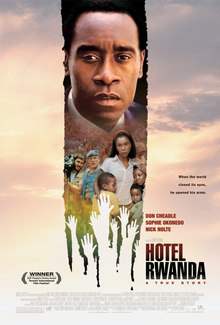 Movie: Hotel Rwanda
 Song: War Child by Emmanuel Jal
Book: Not on Our Watch: The Mission to End Genocide in Darfur and Beyond
Ima
 ge:
ge:
Subscribe to:
Comments (Atom)